Why the Ayurvedic tradition reveres a fat we have learned to fear.
We have learned to look at fat with suspicion. Butter, cream, oil, all of it something to ration rather than something to celebrate. And then there is a substance that has been treated in exactly the opposite way for thousands of years: made in a process of its own, used in therapy, kept for years, and not worse with age, but more precious.
Its Sanskrit name is Ghrita. We call it ghee. It is not a fat to fear. It is a fat that nourishes without burdening.
What ghee is
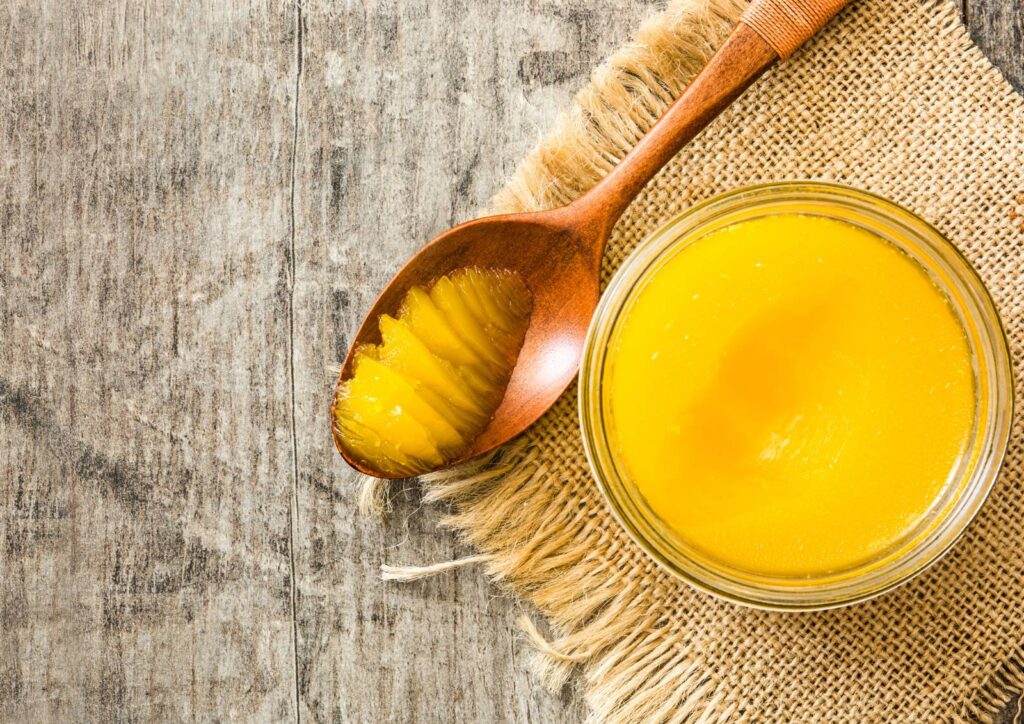
At its core, ghee is simple: butter from which gentle heating has removed everything it does not carry. The water evaporates, the milk solids separate from the fat. What remains is the pure fat substance, golden, clear, with a warm, nutty scent.
Exactly what the process removes is what makes butter hard to digest for many people. Without the milk solids, ghee is therefore tolerated even by people who react sensitively to dairy. Without water it keeps for months, traditionally for years. And it withstands high heat in cooking without smoking. The heavy becomes light, the burdening becomes nourishing.
Why ghee carries differently
Beyond the craft, the tradition knows another layer. Three qualities make ghee what it is.
It carries Sneha in its purest form. Sneha means oil, and it means love. Ghee carries this nourishing, softening quality in a concentration few other substances reach.
It is a carrier. In classical pharmacy, ghee takes up the potency of other substances and carries it deep into the tissues, into fine layers that other carriers do not reach. An herb cooked in ghee works differently from the same herb in water. This is why the classical formulas are almost always ghee-based.
It cools. Unlike sesame oil, which warms, ghee is cooling. It nourishes without heating. That makes it especially valuable for Pitta constitutions and for any state where heat already sits in the system.
Ghee in everyday life
Three or four simple uses, deeply rooted in tradition, with no need for professional guidance.
In the meal. The simplest and deepest use. Ghee belongs in the warm meal, over the rice, in the kitchari, on the steamed vegetables. One to two tablespoons a day is a normal amount, not a cautious addition. It joins with the tastes it accompanies and carries them further than they would go alone. It kindles Agni without overburdening it. And when the fire burns too sharply, with reflux or burning in the upper belly, it cools in a way other substances cannot reach.
In warm water in the morning. Half a teaspoon of ghee in a cup of warm water, first thing in the morning. It wakes Agni gently and brings a light lubrication into the digestive tract. Valuable for dry Vata constitutions, less fitting with Kapha burden or Ama.
On the navel. A calm evening practice. Before sleep, place a teaspoon of warm ghee into the navel, which holds it through the night and takes it in through the skin. Classic for inner dryness in the lower abdomen, gentle, without drama, especially in the colder season.
As Nasya. A few drops of warm ghee into each nostril, especially in the evening with dry mucous membranes. Through the nose it reaches the finer layers of the head and calms the nervous system toward the night.
Beyond these daily uses, the tradition knows powerful practices with medicated ghee, the oiling of the eyes, the drinking of ghee to prepare for deeper treatments. These belong in professional guidance, not in going it alone.
When ghee is not the right choice
An honest note, because ghee is not equally good for every situation. With a clear excess of Kapha together with Ama, it tends to deepen the heaviness rather than dissolve it. With acute digestive troubles and Ama, the clearing has to come first, before ghee helps. With very high cholesterol or certain metabolic conditions, an individual assessment is worth it before larger amounts come in. As everywhere in Ayurveda: the situation decides, not the rule.
A question of quality
Ghee is not just ghee. Industrially made ghee of unclear origin does not carry what traditionally clarified ghee from organic, pasture-raised dairy carries. Look for a golden color, a warm, lightly caramel scent, a soft consistency. For anyone who wants to make their own ghee, it holds a beautiful, almost meditative practice that deepens the understanding of this substance.
What really happens
What ghee changes in everyday life is hard to put in a single sentence. It is not a spectacular effect, no dramatic before and after. It is more a shift in the ground the system stands on. The meal becomes more complete. Something in the body grows calmer, more supple, less dry.
That is what the tradition means when it calls ghee the gold of Ayurveda. Not because it is precious or expensive, but because a single substance carries so much of what the whole teaching wants to reach: nourishment, suppleness, refinement, and the ability to bring all of it where it is needed.
What you need for it: a good ghee from organic, pasture-raised dairy, traditionally clarified. (Recommendation to follow.)
Ghee turns up in more places than you would think: it is the evening Nasya in the Ayurvedic morning routine and a related Sneha to Abhyanga. And how to make your own ghee will soon have a recipe of its own.
Going deeper? If you want to know why a single substance works through all seven layers, you will find it in the book “Die sieben Schichten”.