We have learned to call it “waste,” or “toxins.” Detox teas promise to flush it out, cleanses to be rid of it. But that misses what Ama is. Ama is not a poison that has to be scrubbed from the body. It is something simpler, and more precise.
The word itself
Ama means raw. Unripe. Not cooked through. It is the opposite of pakva, the cooked, the ripened. And this is the image that carries everything: the body is cooking, without pause. It takes in the raw, food, impressions, experience, and ripens it into something it can use. Ama is what stayed raw. What came in, but was never transformed all the way through.
It is not some foreign substance that has entered you. It is your own, only unfinished. Left lying where it should not.
Its signature
Ama carries a recognizable signature, read again in qualities: heavy, sticky, cloudy, cool, dull, foul. Where there should be clarity and flow, Ama is what clings, clouds, weighs down. It clogs the channels through which the body nourishes and cleanses itself. It makes functions sluggish. It is the trace of a fire that could not finish its work.
Recognizing it
The tradition names clear signs, and the modern Ayurvedic view describes the same ones. The clearest is the tongue in the morning: not the thin, whitish film that is normal, but a thick, sticky, whitish-yellow coating that barely comes off and returns the next morning. The tongue is the small daily display of the digestive tract.
Then there is heaviness and sluggishness after eating. A tiredness that sets in without exertion and that sleep does not lift. A foul smell, on the breath, in the stool, on the body. Stool that is sticky, heavy and foul, that sinks in water, often with undigested remnants in it. Urine that is cloudy instead of clear. Little appetite, a pasty taste in the mouth, sometimes a thick congestion. And a mental fog, a diffuse inner cloudiness in which thoughts turn sticky instead of coming and going.
Ama does not stay in the digestive tract. It circulates along and settles where a tissue is already weakened. A classic picture of this is the joints: when Ama settles there together with Vata, what the tradition calls Amavata arises, with stiffness, especially morning stiffness, with heaviness and wandering pain. It is the ground of what the modern view often connects with rheumatic conditions.
Some modern interpreters draw the line further still, toward what deposits in the vessels and narrows them, toward the quietly smoldering inflammation behind many chronic conditions. Classically this is not called Ama, and it is not a claim this text makes. But the quality is the same: the sticky, the narrowing, the not-flowing. It is worth recognizing.
And a note that connects two doors: the tiredness that sleep cannot reach has more than one source. It can be a depleted Rasa layer, and it can be Ama that clouds the ground. Often it is both.
Where it comes from
Ama arises from a fire that does not finish. From the weak fire, Manda, that does not cook through. And from the irregular one, Vishama, with its weak phases in which the transformation stays incomplete.
Not from the sharp fire. Tikshna Agni forms no Ama; it brings forth the opposite: it overheats what comes in, produces acid, heat, irritation, and over time consumes the body’s own substance. That is a different movement, just as serious, but not the left-behind, rather the burned.
The unlived stays raw, too
Not only food asks to be digested. Experience does too. Grief that was never grieved, anger that was never spoken, fear that was never met, they stay raw in the system. Ama on a finer level. They cloud clarity. They sit as heaviness, or as a heat that will not yield. They too are the undigested, left behind.
Why it matters
Over years, what has gathered as Ama becomes the ground on which chronic patterns grow. Ama is not the illness. It is the burdened soil in which other things take root.
From this follows what may be Ayurveda’s most important teaching about order: before substance can be built, Ama must be cleared. To nourish a system full of Ama is to lay the good on top of the left-behind. It does not arrive where it should. It joins what already lies there. And so: first bring Agni to its center, then clear Ama, and only then nourish.
How it clears
And here an honest correction to the word “detox”: clearing Ama is not the adding of a tea. It is the opposite of adding. It is lightening, in Sanskrit Langhana, the making-light.
Before any of it takes hold, there is a question: where does the Ama come from? A weak fire needs a different movement than an irregular one. And Ama that sits deep or has lasted long belongs in experienced hands, not in the grip of a detox promise. Only once the cause is clear can the way be set.
What almost always helps is movement. It is the most important thing. A sluggish fire (Manda) is heavy, and heaviness answers to movement: stronger, warming, into a sweat. An irregular fire (Vishama) cannot take that; it needs the gentler, the lighter, above all the regular, not too much. And sweating itself clears: movement in moderation, sauna, warmth, in Ayurveda long part of dissolving Ama, as Svedana.
Then the food: warm, simple, easy to digest, so that the fire is not overwhelmed; Kitchari is the classic example. Space between meals, so the fire can catch up. Sometimes a day of lighter fare. None of this is deprivation, none of it is punishment. It is giving the fire the chance to finish cooking.
And rhythm: reliable mealtimes, sleep, a day with shape. The irregular fire especially finds its way back through this.
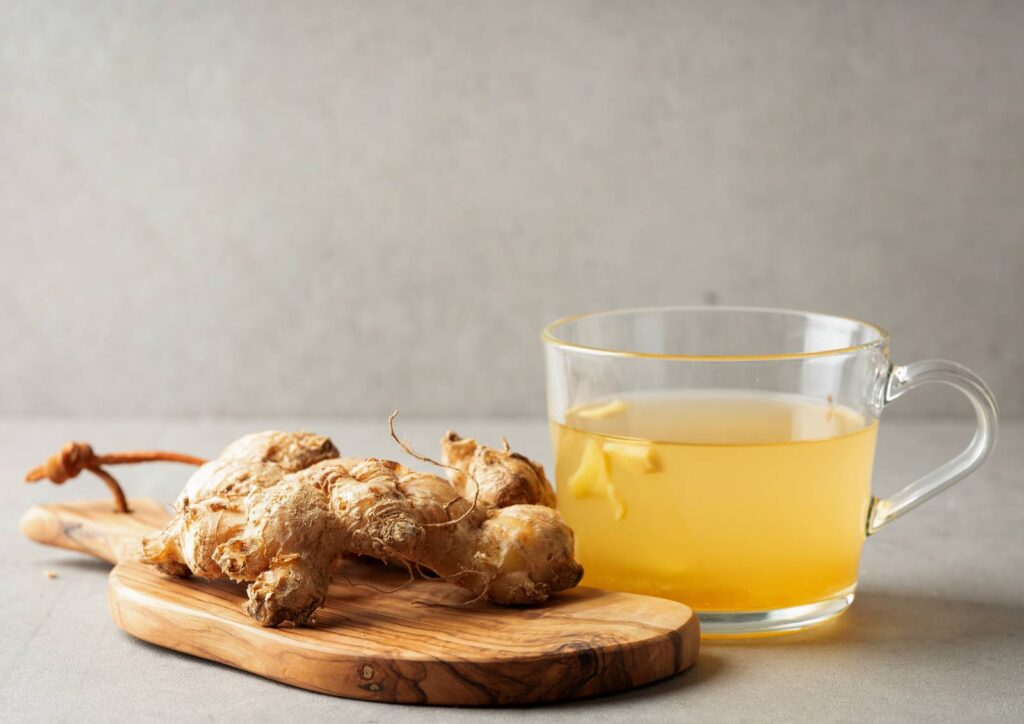
Warming spices help where the fire is weak or irregular: ginger, pippali (long pepper) and black pepper, classically combined as Trikatu, kindle Agni and help to digest Ama. For a sharp fire they would be too much; here the difference shows again. Which herbs, in what form, for how long, that is individual and belongs to the deeper, personal work.
The tongue shows you the way: as Agni grows clearer, less coating appears in the morning. That is the quiet, reliable feedback that the left-behind is lessening. More about the Ayurvedic morning routine you find here.
A last thought
Ama is nothing foreign in you that must be fought. It is the unripe, waiting to be cooked through or gently let go. The body knows how, as soon as the fire is given back its room.