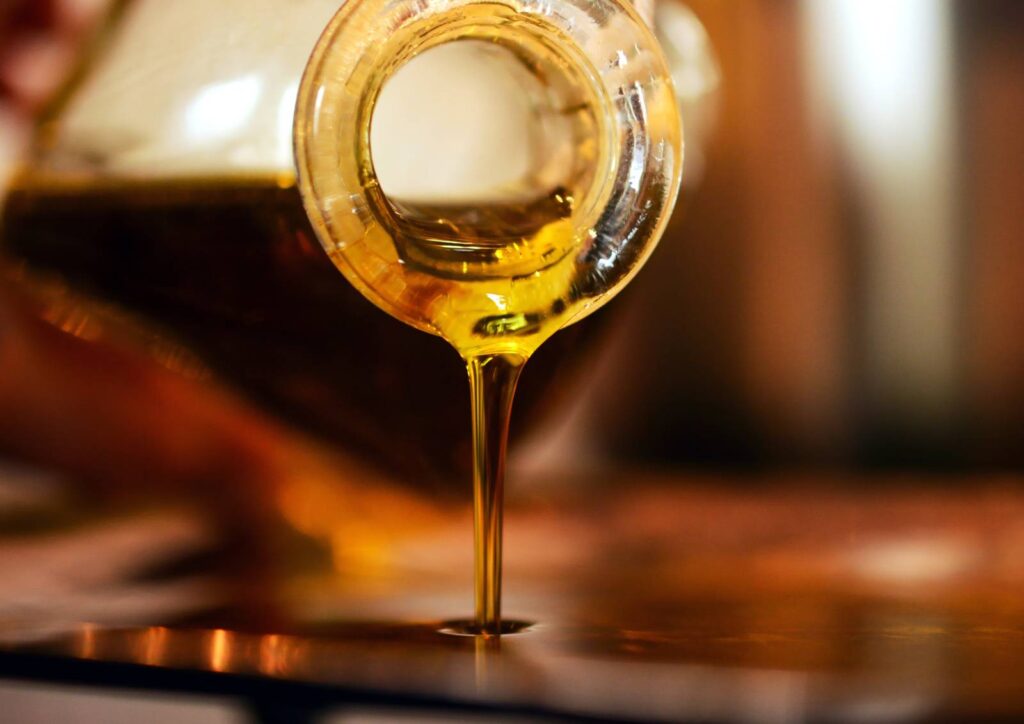
Why warm oil is more than skincare, and how the old practice looks in everyday life.
Maybe you know that long story with creams. You try one, then another, each one a promise, each one a brief flare and then back to dryness. The skin stays thirsty, no matter what you put on it.
Ayurveda knows a simple reason for this, and a different answer. It is called Abhyanga, the daily oiling of the body, and it has been practiced for thousands of years. There is one Sanskrit word at the heart of it: Sneha. It means oil. And it means love. In Ayurveda, that is no coincidence.
Why oil and not cream
Dry skin carries the qualities of Vata: fine, light, cool, dry. What it needs to find its center is the opposite: heavy, oily, warm, nourishing. That is exactly the quality of oil.
The difference is physical. When you apply warm oil, it passes through the layers of the skin and nourishes the tissue deep down, not only at the surface. When you apply a water-based cream, the water takes moisture from the pores as it evaporates, and the skin becomes drier than before.
From this follows the Ayurvedic order: oil before the shower, not after. The oil goes onto dry skin, is given time to work, and only then comes the warm water. Whatever oil remains has already done its work.
And it goes deeper than the skin. The skin is an organ of reception, not a passive coat. What you apply is taken in, and a good oil, matured with herbs, carries substances through the skin into the tissue that would otherwise go through digestion. Sneha does not only carry itself into the skin. It carries with it whatever it holds.
Which oil for which constitution
Not every oil carries every constitution the same way. Here the tradition draws fine distinctions, and it is worth following them.
Vata (dry, light, cool). Warm sesame oil is the classic choice: heavy, penetrating, deeply nourishing. Among the medicated oils, a few have proven especially good: Mahanarayana Taila (deep into tissue and joints), Dhanvantaram Taila (sweet, grounding), Bala-Ashwagandha oil (when substance and calm are needed at once). Vata can take plenty of oil, often daily, often generously.
Pitta (hot, sharp). Sesame oil is often too much in the hot season. Here cooling, coconut-based oils come in, soothing for overheated skin. Among the classic variations, Ksheerabala Taila fits (cooling despite its sesame base) and Eladi Taila (for sensitive, easily inflamed skin). In modern Western use, olive oil has also proven itself, an adaptation to the local climate that does not appear as such in the classical texts.
Kapha (heavy, slow). Here the situation is different. Kapha skin is often rich and well nourished by nature; generous oiling can deepen heaviness and stagnation. If oil, then little and with a stimulating quality (Sahacharadi Taila). More often, though, the tradition recommends something else: Garshana, the dry massage with raw-silk gloves, or Udvartana, the powder massage. The friction stirs the lymph and circulation and brings movement into a system that tends toward inertia. For Kapha this is often more effective than any oil.
Which constitution is strongest in you is shown by the dosha test. (To follow.)
Before you begin
A few preparations make the practice easier:
- A warm room, the bathroom works well.
- Lay down an old towel or a non-slip mat, since sesame oil stains and does not fully wash out.
- Warm the oil: put three to four tablespoons for the whole body into a small bottle and set it in warm water until it feels pleasant on the skin, never hot.
The practice in everyday life
Abhyanga does not have to be a long ritual every day. The tradition knows two forms.
On most days the short form is enough: a small amount of warm oil, rubbed over the whole body, then the shower. A few minutes, and yet noticeable, on the skin, on the nervous system, on the calm with which you go into the day.
On other days, when there is time, the full form is worth it: more oil, slow movement from head to feet, a conscious pause before the shower. Half an hour or more. Not a duty, but care that carries, when everyday life has been especially demanding.
The movement follows a simple logic: from top to bottom. Long strokes over the long bones, circling movements over the joints.
- The head traditionally takes its own oil, not the warming sesame oil of the body, but a cooling, calming head oil such as Bhringaraj or Brahmi (often coconut-based, for instance as Brahmi-Keram). Work about a tablespoon into the scalp in circles. This nourishes the hair, grounds you, and calms a restless mind. The ears too, they carry a particularly soothing effect.
- Arms and legs: long strokes along the bones, circles at the joints.
- On the belly, large slow circles clockwise, following the direction of the large intestine, which supports digestion.
- The feet last, with the most care. They carry the whole body, and their soles are linked to the marma points that lead to the inner organs.
After the massage
The pause before the shower is not optional. In this time the oil passes through the layers. Classically twenty to thirty minutes, which can be used, for gentle yoga, for pranayama, for sitting quietly, or for the oil pulling from the morning routine.
Then a warm shower. After washing, a fine film of oil stays on the skin, and that is exactly right: it protects and nourishes through the day. A small, practical note: the oil does not wash out completely. Keep an older bathrobe ready, not the new yoga pants.
When Abhyanga is not the right choice
There are situations where the tradition advises caution: in acute illness with fever; in the first days of a cold, when the system is clearing something out (oiling would block that movement); with acute, inflamed skin conditions; with a clear excess of Kapha together with Ama. In pregnancy, some variations are to be chosen differently. Anyone with a chronic illness is best to seek Ayurvedic guidance before beginning a daily practice. What is care for one system can become a burden for another.
What really happens
What shows itself in the practice is not mainly the effect on the skin, even though the skin changes, slowly, over weeks. What shows itself first is a calm. A kind of groundedness. The nervous system answers the oil as if something that had been in constant, slight tension could finally lean back.
Perhaps that is what Sneha teaches most deeply: that care does not have to come from discipline. It can also come from tenderness. The ten minutes in the morning, when you apply warm oil to your own body, are not a task. They are a small form of love that the body receives. And the body answers. Not loudly, not at once. But it answers.
What you need for it: a good oil, matched to your constitution (sesame for Vata, coconut-based for Pitta, little or Garshana gloves for Kapha). (Recommendations to follow.)
Which oil suits you? That depends on your constitution. (Dosha test to follow.)
Going deeper? A related daily substance is ghee, the golden oil of the Ayurvedic kitchen. Why the tradition treasures this golden fat, you can read here. And if you want to know why the oil reaches through the skin into the layer of the nervous system, you will find it in the book “Die sieben Schichten”.